Khal’s Basilisk Poisoning and Rescue
The Reincarnated Demon King's Host Just Wants to Live in Peace, But the Hero Won't Leave Him AloneKhal’s Basilisk Poisoning and Rescue is the crisis that brings Healer Theo into direct service of Luc’s Hero’s Party. A day after Khal is bitten by a basilisk, the party carries him into Theo’s cramped home, where darkening wounds and spreading venom make death appear imminent. Theo saves the half-orc through a dangerous, painful treatment that requires him to reveal the full force of his healing magic in front of the very Heroes who would hunt him if they learned what he was. Khal’s survival establishes Theo as an indispensable healer, begins the party’s trust in him, and turns a medical emergency into the first major test of his divided loyalties.
Causes and Background
The party arrives at Theo’s door because ordinary healing has failed. Luc explains that their friend was bitten by a venomous demon spawn the previous day and that the group’s efforts have not worked, while the surrounding townsfolk have directed them to the healer reputed to work miracles. The party has no healer of its own; the role is supposed to belong to Luc, but he cannot treat Khal. Their need is therefore both immediate and structural: Khal is dying, and the Hero’s Party has reached the limit of its available skills.
Theo understands the danger before he agrees to help. Mal warns that these are the people who would hunt and hurt them if they discovered Theo’s true nature, and Theo knows that no amount of friendship would save him if the secret became public. Nevertheless, he concludes that he has no choice and orders the party to bring Khal inside. The decision places his safety beneath Khal’s life, but not without resistance. Theo resents having to display his powers before the Heroes, while Mal reminds him that he chose this situation by allowing the party into his home.
The emergency is made more alarming by Khal’s condition and by the setting in which Theo must work. Theo’s potion-room kitchen is not large enough for the entire party and the enormous pig accompanying them. The companions push his cooling dinner onto the floor to make room for Khal on the massive oaken table, turning the healer’s domestic space into an improvised treatment room. Khal’s tusklike lower fangs and reddish skin identify him as partly orc, a hardy heritage that has delayed the poison’s progress but has not stopped it.
The Poison and Khal’s Condition
When the dwarf mage begins removing Khal’s armor, Theo sees two puncture wounds on the warrior’s torso. They are no longer bleeding, but each has turned dark purple, and discolored veins are spreading beneath the surrounding skin. Khal’s normally tan complexion has become ashen, and sweat covers him as he lies unconscious. Mal identifies the attacker as a basilisk and states that Khal should already be dead. The diagnosis makes the wound more than a conventional injury: basilisks are demon-made creatures, and their blood and venom contain dark magic.
The party has attempted revival spells rather than a targeted treatment. Emi, the priestess, has been casting them every hour with Avery and Veiv, while Avery insists that their healing spells have been sufficient. Khal’s body contradicts that confidence. The masked party member supports Theo’s earlier assessment by pointing out that the injured man is still in danger, and Theo realizes that herbs or potions have not been used to slow the venom. Mal recommends vynnil root for lasting damage but warns that Theo will need to throw all his healing talents into the treatment.
The diagnosis creates a sharp contrast between the party’s public identity and its actual vulnerability. These are the Heroes who are expected to confront demon-made threats, yet one of their own lies helpless before poison they cannot remove. Theo, a fugitive from the heroic path and a hidden demon host, becomes the only person capable of addressing the crisis. The party’s dependence on him begins not through shared ideals or formal allegiance, but through Khal’s failing body on Theo’s kitchen table.
Emergency Treatment
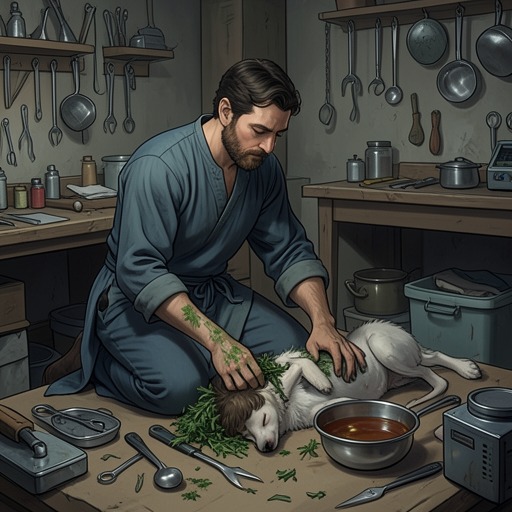
Theo starts by cutting an X across each puncture wound with a hot knife, causing fresh red blood to spill from injuries that had stopped bleeding. Khal jerks awake under the incision, and his companions lunge forward to pin him down. Theo discards the knife and raises both hands over the wounds, allowing his magic to rise. The procedure is deliberately invasive: he opens the poisoned flesh so the venom can be reached, then applies healing power directly to the source of the damage.
Theo’s magic appears calm, glowing deep emerald around his hands, but its calmness contains the possibility of sudden destruction. He recognizes that the same qualities associated with still water, summer weather, and the moments before dawn can become chaos in an instant. The party murmurs nearby while he works, and Luc’s attention remains fixed on him. Theo is forced to manage two dangers at once: Khal’s basilisk venom and the scrutiny of a Hero whose recognition could expose him.
The healing is the most difficult wound Theo has ever treated. Khal repeatedly jerks against the silk restraints and the grip of his companions, screaming as Theo destroys the poison without having enough magic left to ease the pain. Theo’s arms begin to shake, the only visible sign of his exhaustion, but he continues until the last of the venom dissipates. The presence of demon magic in basilisk blood makes the treatment especially demanding, because Theo must overcome an active supernatural poison rather than merely close damaged tissue.
Once the venom is gone, Theo redirects his power to remove Khal’s pain temporarily, allowing the warrior’s large body to relax against the table. He then calls for vynnil root and sprinkles the powder over the wound, treating it with the practical precision of seasoning food. The gesture joins the extraordinary and the ordinary: emerald magic has neutralized a poison that should have killed Khal, while a humble medicinal powder is used to guard against lasting damage. Rescue is therefore presented as both miracle and craft, dependent on knowledge, endurance, and the willingness to endure another person’s pain.
Recovery and Return to Duty
Theo’s intervention does not end with the poison’s disappearance. The party returns less than three minutes after the initial request, bringing a rented horse and cart so Khal can be transported to the Broken Blade. Emi removes the silk bands, and Theo takes away the pads covering the injury so he can inspect the flesh directly. The wound bleeds when uncovered, but his green magic finds no remaining poison, and within a minute the punctures close. Luc and Veiv help Khal sit upright, while Theo gives him a bowl of broth and prescribes one more day of bedrest followed by two days of light movement.
The recovery plan is deliberately measured rather than triumphant. Khal has survived a venom that should have killed him, but Theo does not confuse survival with immediate readiness. The healer treats restored function as something that must be tested and protected. Khal’s gratitude is direct, yet Theo’s authority is expressed through practical limits: food, rest, gradual movement, and continued observation are as necessary as the original burst of magic.
The next day, Khal is already at breakfast in the Broken Blade, eating an enormous meal of bacon and eggs and reporting that he has been stretching and walking. He is eager to return to training, but Theo performs a further examination before granting permission. Placing a hand over the site of the former wound, he lets green light wash across the room and scans Khal’s entire body. Finding no abnormality, Theo clears him to return to duty while advising him to maintain his water intake. Khal then rises, towering over the party, and announces that the break is over, prompting groans from everyone except Emi. His restored strength converts the crisis into a visible return of ordinary group life.
Consequences for Theo and the Party
Khal’s rescue makes Theo useful to the Hero’s Party in a way that cannot be dismissed as rumor. The party came because townspeople said he worked miracles, but it leaves with concrete evidence: he diagnosed a basilisk wound, neutralized demon-tainted venom, closed the damage, and monitored the patient through recovery. Khal’s survival therefore changes Theo’s position from an isolated village healer to a person whose skills the party may depend upon when conventional heroic resources fail.
That usefulness carries a concealed cost. During the treatment, Theo has to expose the scale and character of his magic before people who would become his enemies if they learned he was a demon host. His fear is not abstract. He knows that friendship would not protect him from discovery, and later Cargo asks whether he will tell the party that he is demon spawn. The question freezes Theo and brings Mal forward, showing that the rescue has created intimacy and suspicion at the same time. Every successful act of healing makes Theo more visible; every act of visibility threatens the secret that keeps him alive.
The event also establishes a recurring ethical pattern in Theo’s story. He does not help because the party is safe for him, trustworthy in every respect, or politically harmless. He helps because Khal is dying and because Theo possesses the ability to prevent that death. Later, when Luc is endangered in the capital, Theo again accepts the loss of his autonomy because Luc might die without him. The basilisk crisis is the first clear instance of this principle: Theo’s healer’s duty overrides his instinct to run, even while Mal correctly identifies the people around Khal as potential hunters.
Wider Narrative Significance
The poisoning exposes the limits of the heroic system as well as the strength of individual care. Luc’s party possesses warriors, a priestess, mages, revival spells, and the authority associated with Heroes, yet repeated healing attempts cannot stop the basilisk venom. The answer comes from Theo, whose hidden identity places him outside the system the party represents. The supposed enemy’s power is therefore not simply destructive; in Theo’s hands, knowledge associated with demon magic helps him understand and overcome a demon-made poison.
This contradiction becomes important as the story moves toward later conflicts over identity and allegiance. Theo’s work in the kitchen is not a public declaration, and the party does not yet know what he is. Their dependence begins through the body of Khal, whose danger forces them to recognize competence before they can categorize the person providing it. The later court proceedings, where Theo is imprisoned for protecting Malthios, reveal the political opposite of this scene: the capital treats his hidden connection to the Demon King as grounds for judgment, while the immediate crisis allows his actions to be understood through their life-saving result.
Khal’s recovery also gives the party a reason to remember Theo not merely as a suspicious village healer but as the person who returned one of their own to full health. At the Broken Blade, Khal’s appetite, height, command to resume training, and the companions’ collective complaints provide the event’s final image. The danger that filled Theo’s kitchen with blood, restraints, and spreading purple veins has been replaced by familiar irritation and shared routine. The rescue thus carries two outcomes at once: Khal is restored, and Theo is drawn closer to the people whose acceptance he needs but cannot safely trust.